
Financial Disclaimer: This content is for informational purposes only and does not constitute financial, investment, or legal advice. We are not licensed financial advisors. Always consult a qualified financial professional before making any financial decisions.
Wealthfront Product Profile
The robo-advisor that went furthest on tax optimization — best tax-loss harvesting and the $500 minimum to start
Editorial review record is being refreshed.
Affiliate disclosure: Some links may earn a commission on qualifying purchases. Product profiles distinguish provider information from independent editorial reviews; we do not publish a rating or ranking without supporting evidence. Paid content is labelled and cannot buy a score, ranking, or favorable conclusion.
Product resource
Wealthfront
Free plan available
The Bottom Line
Wealthfront is The robo-advisor that went furthest on tax optimization — best tax-loss harvesting and the $500 minimum to start. This profile summarizes the product's current positioning, available features, pricing notes, and primary sources while the independent editorial review record is being refreshed.
What is Wealthfront?
Wealthfront was founded in 2008 by Andy Rachleff and Dan Carroll in Palo Alto, CA. It launched as one of the first two robo-advisors (alongside Betterment) and has competed directly ever since. Wealthfront manages $50B+ in AUM for 800,000+ clients. A planned acquisition by UBS for $1.4B fell through in 2022. Wealthfront has since operated independently and expanded its product to include banking (Wealthfront Cash Account), loans (Portfolio Line of Credit), and the Path financial planning tool.
What does Wealthfront offer?
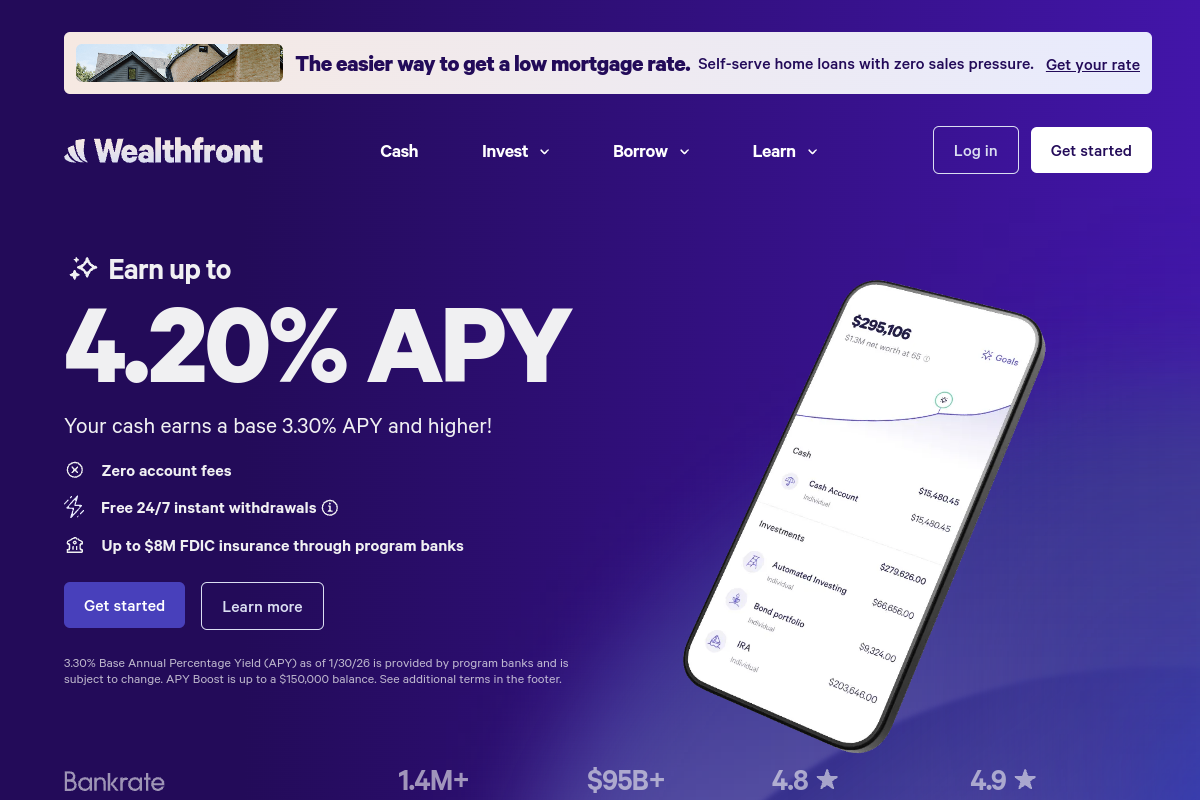
Wealthfront Digital Advisor (0.25%/yr, $500 minimum) manages diversified ETF portfolios with automatic rebalancing and daily tax-loss harvesting. Stock-Level Tax-Loss Harvesting (direct indexing) available for taxable accounts with $100K+. Risk Parity portfolio (alternative allocation strategy) available for $100K+. US Direct Indexing for $100K+ portfolios. Cash Account: FDIC-insured up to $8M through program banks, 4.5%+ APY. Portfolio Line of Credit (borrow against portfolio at competitive rates). Path: personalized financial planning tool integrating accounts, income projections, and retirement scenarios.
Digital Advisor (0.25%/yr)
Custom
/month
Cash Account (4.5%+ APY)
$0
/month
Editorial assessment refresh
We are re-sourcing our prior score and tier before publishing a numerical rating or testing claim for this product. The product details, pricing notes, and linked sources remain available while that work is completed.
Ready to try Wealthfront?
Get Wealthfront →Frequently Asked Questions
Is Wealthfront worth it in 2026?
Wealthfront has a current product profile, but we are not publishing an independent value verdict until its editorial review record is sourced. Confirm current pricing, limits, and fit with the provider.
What is Wealthfront best for?
Wealthfront is best for: High-income investors with $100K+ taxable accounts who want direct indexing tax optimization, Passive investors who want the most tax-efficient robo-advisor on the market, Anyone wanting a high-yield cash account alongside their investment portfolio.
Does Wealthfront have a free trial?
Wealthfront does not offer a permanently free plan. Contact the provider for current pricing.
What are the best Wealthfront alternatives?
Top alternatives to Wealthfront include betterment, fidelity, m1-finance.
Review the current product details and sources above, then confirm plan limits and pricing directly with the provider before choosing a plan.
Get Wealthfront →